World Tsunami Day
Saturday 5 November is World Tsunami Day.
It’s a chance for us to prepare for, and learn more about our tsunami risk
www.happens.nz has tips for families to be prepared, including advice on how to evacuate, assemble getaway bags, and develop personal, family and workplace emergency plans.
Learn more about tsunami at www.happens.nz/types-of-emergencies/#tsunami
Download and share these posters to help people find out more about tsunamis.
What is a tsunami?
A tsunami is a series of fast travelling waves caused by a large disturbance in the sea or on the ocean floor, such as an earthquake, landslide, volcanic eruption or meteorite. The waves can be an hour apart, and can travel many thousands of kilometres across the oceans at great speeds of up to 800 kilometres per hour.
A tsunami may go unnoticed as it crosses deep oceans, but it loses speed and gains height when it reaches shallow water. Large waves up to 15 metres or more in height can come crashing onto the land.
Even small tsunami waves can be dangerous, causing unusually strong currents and unpredictable water flows near the shore. This means a threat to beach, harbour, estuary and small boat activities.
In the last 200 years, there have been at least 3 tsunami that were more than 10 metres high at the New Zealand coast. Māori mythology also speaks of large tsunami. Some were caused by distant earthquakes, some by underwater quakes not far off the coast.
Know the warning signs
There are three ‘types’ of tsunami – local, regional and distant. For a local source tsunami which could arrive in minutes, there won’t be time for an official warning. It is important to recognise the natural warning signs and act quickly.
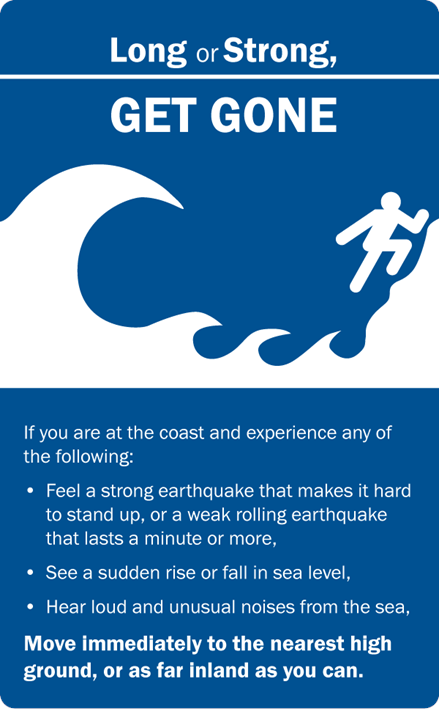
Move immediately to the nearest high ground, or as far inland as you can if you are at the coast and experience any of the following:
- Feel a strong earthquake that makes it hard to stand up, or a weak rolling earthquake that lasts a minute or more,
- See a sudden rise or fall in sea level,
- Hear loud and unusual noises from the sea,
With regional and distant tsunami, we will have more time and you will likely receive official and unofficial warnings. If you get a warning from friends and family, or from civil defence and emergency management services by text, sirens, radio, website, or other means, follow their instructions, and move to higher ground or as far inland as you can.
Make a plan
Early warning saves lives. Know what to do and where to go. Take some time today to make a plan with your family.
During a tsunami warning, some houses, streets and neighbourhoods may not be safe to stay in and you may have to leave home in a hurry. If your street was evacuated where would you go? What would you take? What about pets? Do you have neighbours who might need your help?
www.happens.nz has tips for families to be prepared, including advice on how to evacuate, assemble getaway bags, and make plans.
Practise evacuating to a safe zone
You can hold your own tsunami drill at work. Contact your local council to find out the safe zones in your region and practise getting there as quickly as you can by walking. You could also hold an earthquake drill first, to make sure everyone knows the right action to take during an earthquake – drop, cover and hold – before you practise evacuating.
All of New Zealand’s coastline is at risk of tsunami. Early warning saves lives. Know what to do and where to go.
When a Tsuname does hit New Zealand don't be surprised, it has happened before.
- Last updated on .